Tape Doesn't Lie: The Underground Movement Hiding Secrets on Magnetic Ribbon
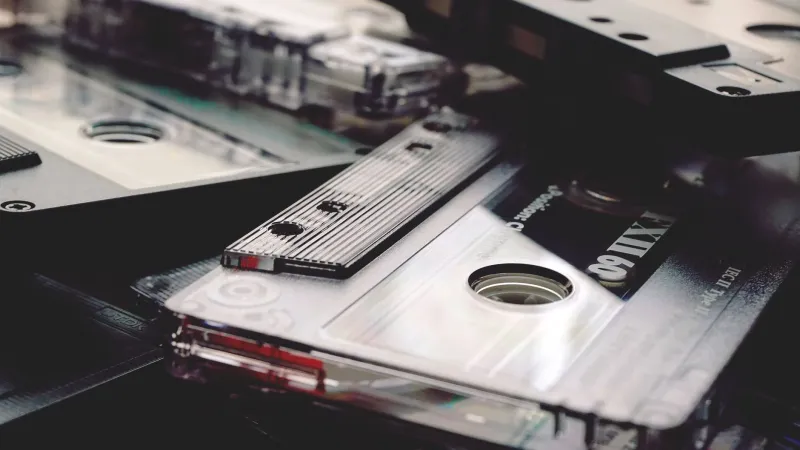
There's a guy in Portland — he goes by Ferric, which is either a reference to ferric oxide tape coating or just a really good pseudonym, possibly both — who hasn't stored anything sensitive on a digital device in three years. Not passwords, not personal correspondence, not the kind of documents that tend to accumulate when you're paying attention to the world. All of it lives on cassette tapes, organized in a system he describes as "deliberately inconvenient by design."
"If it's annoying to access, it's annoying to steal," he says. "That's the whole architecture."
Ferric is not alone. Scattered across American cities and rural towns, a loose network of archivists, activists, musicians, and privacy obsessives has quietly revived magnetic tape not as a vintage hobby but as a functional countermeasure. These aren't audiophiles chasing warmth in the high frequencies. These are people who've thought hard about what digital storage actually means — who owns it, who can read it, who can intercept it — and decided that a $2 cassette bought at a thrift store in Cincinnati is a more trustworthy vessel than any server farm in Virginia.
The Metadata Problem Nobody Talks About Enough
Here's the thing about digital files that most people don't fully reckon with: they talk. Every document, image, audio recording, and message you create digitally carries embedded information about when it was made, on what device, sometimes where, and often by whom. Strip the content and the container still narrates your behavior. Archivists call this metadata. Privacy researchers call it a liability. Ferric calls it "the file's confession."
Magnetic tape doesn't confess. A cassette recorded in 1987 and one recorded last Tuesday are, to any casual inspection, identical objects. There's no embedded timestamp, no device fingerprint, no cloud sync event logged somewhere in a data center. The information exists in the physical arrangement of iron oxide particles on a strip of plastic. To read it, you need the tape, a working deck, and the patience to actually sit there and listen.
That friction, counterintuitively, is the point.
"Digital is frictionless, and that frictionlessness is a trap," says a Chicago-based archivist who asked to be identified only as M. She's been cataloguing sensitive community organizing materials on tape for the better part of two years, using a combination of spoken-word recordings and audio-encoded data — essentially, old-school modem tones that carry text and files when decoded. "The moment something is easy to copy, it's easy to take. Tape is hard to copy at scale. That's not a bug."
Vinyl Enters the Chat
Cassette tape gets most of the attention in these conversations, partly because the hardware is cheap and widely available, and partly because the DIY cassette scene has enough cultural legitimacy that a box of tapes on a shelf doesn't read as unusual. But a subset of this community has gone further, pressing actual vinyl records as archival storage.
This sounds extreme until you do the math. A vinyl record, properly stored, has a functional lifespan measured in decades. It requires no power to maintain its integrity. It cannot be remotely wiped, hacked, or subpoenaed from a third-party provider because there is no third-party provider. The information is literally carved into the surface of a physical disc.
A small pressing operation somewhere in the mid-Atlantic — its exact location not something anyone involved is keen to publish — has been running short-run vinyl pressings for community groups who want archival-grade storage for sensitive materials. They're not pressing music. They're pressing encoded data, audio documents, oral histories, things that need to outlast the political weather.
"Vinyl is a time capsule you control," one person connected to the operation explained over an encrypted call. "Nobody's going to send a subpoena to a piece of plastic in your basement."
The Signal-to-Noise Politics of It All
It would be easy to frame this as paranoia — people who've watched too many surveillance documentaries retreating into an analog fantasy. But that framing misses something real about what's happened to digital infrastructure over the past decade.
Cloud storage agreements routinely include provisions allowing service providers to cooperate with law enforcement requests. End-to-end encryption, while real, depends on the security of devices that are themselves running proprietary software updated by corporations with their own legal obligations. Even offline digital storage — hard drives, USB sticks, SSDs — leaves forensic traces that trained investigators can recover long after files appear deleted.
Tape degrades. Tape wears out. Tape is, in a technical sense, less reliable than a well-maintained hard drive. But that impermanence is, for some people, a feature rather than a flaw. Information with an expiration date baked into its physical medium is information that can't be recovered indefinitely by parties you didn't choose.
"I'm not trying to store things forever," says Ferric. "I'm trying to store things for exactly as long as I need them, and then have them be gone. Digital doesn't do gone. Tape does gone."
The Aesthetic Isn't Incidental
What makes this movement interesting from a cultural standpoint — and why it fits naturally into conversations about art and digital culture rather than just privacy advocacy — is that the aesthetic dimension isn't separate from the functional one. The people involved aren't tolerating the look and feel of analog media as a necessary inconvenience. They're drawn to it.
There's something in the tactile quality of a cassette, the deliberate act of recording and rewinding, the audible hiss that sits under the signal, that feels philosophically coherent with what these communities are trying to do. They're not trying to be seamless. They're not trying to be scalable. They're building something intentionally small, intentionally physical, intentionally present in a way that digital infrastructure, by its nature, cannot be.
M puts it simply: "When I hand someone a tape, I'm handing them a thing. Not a link. Not an access permission. A thing. That means something different."
Static as a Feature
PeciaBK has spent a lot of time in the spaces where signal and noise blur together — the pirate broadcasts, the dead drops, the communities rebuilding contact networks outside of server infrastructure. The cassette revival fits that territory exactly.
This isn't retro. It's not nostalgia cosplay. It's a community that looked at the architecture of modern information storage and decided the static was preferable to the clarity. Because clarity, it turns out, has a price tag attached — paid in metadata, in behavioral data, in the invisible tax of existing inside systems that are watching.
Magnetic tape doesn't watch. It just holds.
And in 2024, that's quietly become one of the most radical things a storage medium can do.