Leave No Trace, Leave Everything: The Hidden Data Caches Rewriting How Secrets Travel

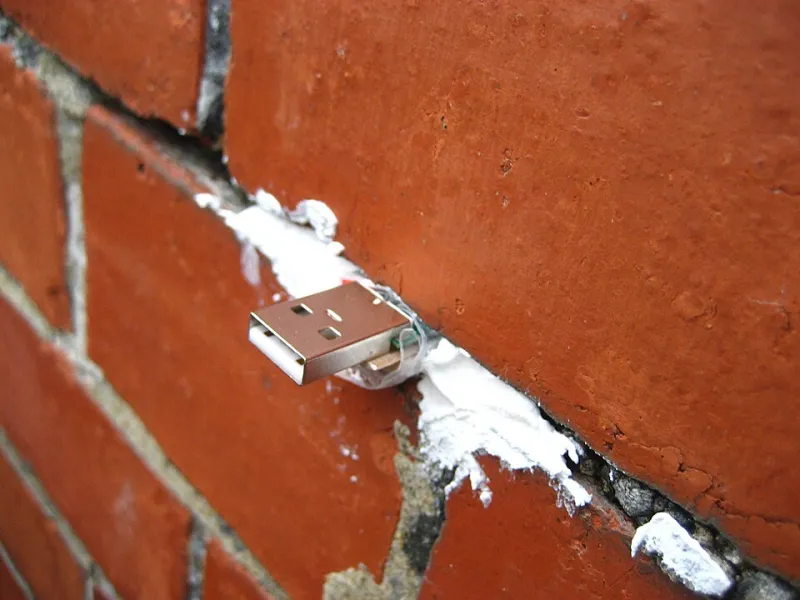
Photo: Lambtron, CC BY-SA 4.0, via Wikimedia Commons
Somewhere in a mid-sized American city — we're keeping which one vague on purpose — a USB drive is embedded in a concrete wall behind a laundromat. It's been there for three years. Hundreds of people have plugged into it. Nobody knows who put it there first.
This is a dead drop. And depending on who you ask, it's either a relic, a prank, or the future of anonymous communication.
From Moscow Rules to Main Street
The concept isn't new. Intelligence agencies have been using physical dead drops — concealed locations where two parties can exchange information without ever meeting — since at least the mid-20th century. The KGB used hollow coins and marked trees. The CIA had chalk signals and loose bricks. The whole point was to break the chain of contact, to move information without creating a visible human link between sender and receiver.
What's changed is who's doing it and why.
After whistleblower revelations in the early 2010s made clear just how comprehensively digital communications were being monitored, a certain strain of privacy-minded person started looking for alternatives. Not everyone went full encrypted-messaging-app. Some went older. Much older.
"The thing about digital encryption is that it still leaves metadata," says one practitioner who goes by the handle Cassette, and who agreed to speak on condition of anonymity. "Someone can know you sent a message even if they can't read it. A physical dead drop doesn't exist in any log anywhere. It's not in a server. It's in a wall."
The USB Art Project That Became Something Else
The contemporary dead drop movement has a surprisingly traceable origin point. In 2010, Berlin-based artist Aram Bartholl began embedding USB drives into walls, curbs, and buildings in New York City as part of an art installation called — straightforwardly enough — Dead Drops. The idea was to create an "offline peer-to-peer file-sharing network in public space." People could walk up, plug in, browse whatever files previous visitors had left, and add their own.
It spread. Fast.
The Dead Drops project now has a public registry with thousands of locations logged worldwide, many of them in US cities. But what started as a conceptual art gesture has developed a secondary ecosystem — one that operates well outside the public registry, that doesn't want to be mapped, and that takes the information-exchange function a lot more seriously.
"The art project opened a door," says a digital security trainer based in the Pacific Northwest who works with journalists and NGOs. "But some people walked through that door and kept walking."
Geolocation Changed the Game
Here's the tension at the heart of the modern dead drop scene: the same smartphone technology that makes mass surveillance possible has also made coordinating a distributed physical network dramatically easier.
Encrypted messaging apps, ephemeral social media posts, and coded location-sharing have allowed dead drop communities to scale in ways that would've been logistically impossible even fifteen years ago. Coordinates get passed through closed forums. Locations are described in deliberately oblique terms — "third pillar from the east entrance, knee height, rough side" — that mean nothing to anyone who isn't already in the know.
Some networks have developed their own geolocation tools, stripped-down apps that look like ordinary note-taking software but function as dead drop registries for vetted members. The irony of using digital infrastructure to coordinate analog communication isn't lost on participants.
"You're using the surveillance apparatus to route around itself," Cassette says. "It's kind of beautiful if you think about it too hard."
What's Actually In There
The content varies wildly depending on the community.
Some dead drops are genuinely mundane — mixtapes, zines, short fiction, the kind of stuff that would've circulated on burned CDs in the early 2000s. There's a whole subculture of people who treat them purely as a creative exchange medium, a lo-fi alternative to the algorithm-driven content feeds that dominate online culture. You plug in, you don't know what you'll find, and that uncertainty is the whole point.
Other drops are more purposeful. Journalists working in environments where source protection is paramount — immigration coverage, labor organizing, certain beats where sources face real retaliation — have begun using physical drops as one layer in a multi-part secure communication protocol. A source can leave documents without ever sending an email, making a phone call, or appearing on any network log.
Activist networks have similar uses. During periods of heightened political tension, some organizers have moved sensitive coordination materials — meeting locations, legal support contacts, security protocols — through physical drops specifically because they generate no digital trail.
"We're not doing anything illegal," one organizer told us. "But we've watched enough of our friends get their phones seized to know that the less that exists digitally, the better."
The Risks Nobody Talks About
Dead drops aren't without hazard, and the community is candid about this.
Plugging an unknown USB drive into your computer is, from a basic cybersecurity standpoint, a terrible idea. Malicious files, firmware exploits, and data-harvesting payloads can all be delivered via physical media. Sophisticated adversaries — state actors, corporate security teams — could theoretically seed drops with compromised hardware.
There's also the legal question. Leaving objects in public spaces can run afoul of any number of ordinances. Post-9/11 security culture means that abandoned objects in certain locations get reported, investigated, and removed. More than a few dead drops have been destroyed by police bomb squads responding to suspicious package calls.
And then there's the surveillance paradox: if you're walking to a specific location, plugging something in, and walking away, you are still a physical body moving through space covered by cameras.
"Nothing is perfect," the digital security trainer acknowledges. "The point isn't to be invisible. The point is to make the cost of surveillance higher than the value of what they'd find."
Signal in the Concrete
What makes the dead drop revival genuinely interesting isn't the technology — there isn't much. It's the philosophy.
In an era where digital communication is essentially synonymous with communication, a growing number of people are making a deliberate choice to go physical, slow, and untraceable. They're betting that the most resilient information network is one that can't be taken offline because it was never fully online to begin with.
The wall behind the laundromat is still there. The USB drive is still in it. Nobody's coming to take it down because nobody in any official capacity knows it exists.
Somewhere between the art project and the tradecraft manual, something new is being built. It doesn't have a name yet. It doesn't have a server. It has a brick wall and a flash drive and the patience of people who've decided the old ways might be the most radical ones left.