Off the Grid, Online: The New Underground Networks Being Built Without Big Tech
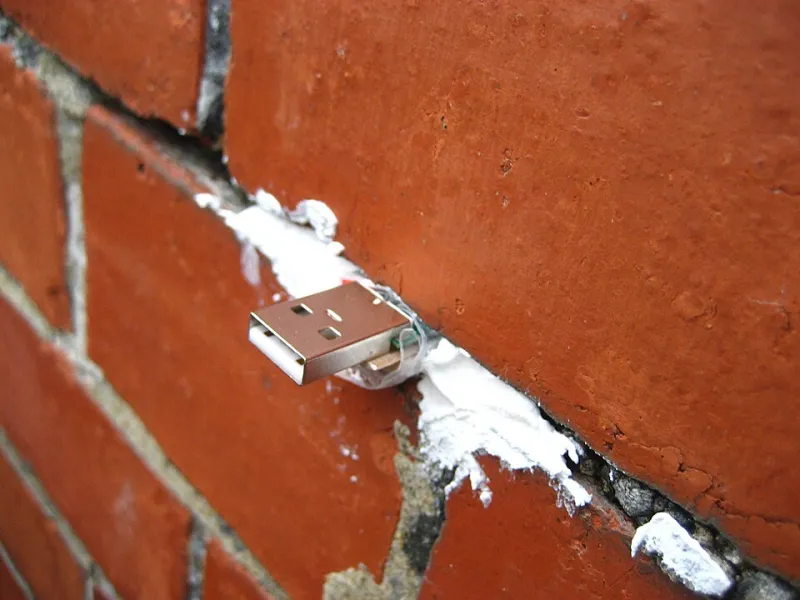
Photo: Jeremy Keith from Brighton & Hove, United Kingdom, CC BY 2.0, via Wikimedia Commons
Somewhere in Brooklyn, there's a USB drive taped to the underside of a park bench. It contains zines, music files, a manifesto or two, and instructions for finding the next one. Nobody owns it. Nobody moderates it. It doesn't have a privacy policy.
This is a dead drop — a concept borrowed from Cold War espionage tradecraft and repurposed for the digital age by artists, hackers, and anyone else who's decided that the terms of service on corporate platforms are no longer worth agreeing to. And it's just one node in a much larger, stranger infrastructure that's been quietly assembling itself at the edges of the mainstream internet.
Why People Are Leaving (And Where They're Going)
The exodus from centralized social media isn't new, but it's accelerating in ways that feel qualitatively different from previous waves of platform skepticism. The early Tumblr refugees, the Twitter power users who set up Mastodon accounts and then mostly forgot about them — those migrations were largely about personal preference. What's happening now has a sharper edge.
Content moderation decisions that feel arbitrary and politically inconsistent. Platform algorithms that actively suppress certain kinds of speech while amplifying others. The monetization of every interaction, down to which posts you linger on for two seconds. The accumulation of these grievances across a wide range of communities — not just the politically marginalized, but artists, researchers, hobbyists, local organizers — has created genuine demand for alternatives that don't come with a surveillance apparatus attached.
The response has been fragmented, decentralized, and genuinely creative. There's no single alternative platform people are flocking to. There's a whole ecosystem of different tools, each suited to different needs, being assembled by communities that have largely stopped waiting for a tech company to build what they actually want.
The Physical Layer: Dead Drops and Sneakernets
The dead drop project — formalized as "Dead Drops" by Berlin-based artist Aram Bartholl around 2010 — involves embedding USB drives in public walls, benches, and structures, creating anonymous peer-to-peer file-sharing points accessible to anyone who walks by with a laptop. The concept never fully went mainstream, but it never died either. In cities like New York, Chicago, and Portland, active dead drops still get updated with fresh content, functioning as tiny physical nodes in a distributed information network.
The appeal is almost offensively simple: a USB drive in a wall cannot be deplatformed. It cannot be algorithmically suppressed. Nobody can buy it and change the community guidelines. The content it holds is whatever whoever loaded it decided to put there, and the only way to access it is to physically show up.
This kind of "sneakernet" thinking — moving data by physically carrying it rather than sending it over monitored networks — has seen a genuine revival among communities that prioritize operational security. Encrypted drives passed between trusted members. Printed newsletters distributed at shows and markets. QR codes chalked onto sidewalks that lead to temporary file-hosting links before they expire. It's clunky by the standards of instant digital communication, but clunky has advantages when the alternative is leaving a data trail.
The Discord Paradox
Here's the awkward middle ground: a huge chunk of the underground community infrastructure being built right now lives on Discord.
Discord is, by any reasonable definition, a centralized corporate platform with terms of service, content moderation, and a business model built around eventually monetizing its user base. And yet it has become the default organizing layer for an enormous range of niche communities — including many that are explicitly skeptical of centralized corporate platforms. The contradiction is real, and people in these spaces acknowledge it.
The working logic seems to be that Discord functions as a low-friction gathering point — a front door — while the actual sensitive coordination and content-sharing happens elsewhere. A Discord server might have thousands of members, but the links to the encrypted Telegram channels, the IPFS-hosted archives, the Matrix rooms, the private Nextcloud instances — those circulate only among vetted members, and they live somewhere Discord can't reach.
This layered architecture, where public-facing spaces on corporate platforms serve as intake funnels for deeper private networks, has become genuinely common. It's not perfect operational security. But it's a reasonable compromise between accessibility and privacy for communities that aren't running intelligence operations — just trying to share art, organize events, or discuss ideas without having their conversations scraped for ad targeting.
The Technical Toolkit
For people who want to go further than Discord, the options have gotten considerably more accessible over the past few years. Matrix, an open-source federated messaging protocol, lets anyone spin up their own server that can communicate with other Matrix servers — similar to how email works, except for real-time chat. Element is the most common client, and the setup barrier, while not zero, is low enough that non-technical users can manage it.
For file sharing and archiving, IPFS (InterPlanetary File System) has become a go-to for communities that want to host content without relying on a single server that can be taken down. Content on IPFS is addressed by what it is rather than where it is, meaning that as long as anyone in the network is hosting a file, it stays accessible. Pairing IPFS with a tool like Filecoin adds a persistence layer that makes archival more reliable.
For the more privacy-focused end of the spectrum, Session — a Signal fork that removes phone number requirements and routes messages through a decentralized node network — has been gaining traction in communities where metadata analysis is a genuine concern. Briar, which can route messages over Bluetooth and WiFi in addition to the internet, functions even when network infrastructure is unavailable.
None of these tools are perfect. All of them have trade-offs. But the fact that they exist and are being actively used by non-technical communities represents a meaningful shift from even five years ago.
What This Is Really About
The practical tools are interesting, but the more significant thing happening here is philosophical. A growing number of people have stopped thinking of communication infrastructure as something that gets provided to them by companies, and started thinking of it as something they build and maintain themselves.
This is a genuinely different orientation toward digital life — one that treats the convenience of corporate platforms as a trade-off rather than a default, and that accepts the friction of decentralized tools as the cost of autonomy. It's not a majority position, and it probably won't become one. But the communities operating from this premise are building things that are increasingly functional, increasingly interconnected, and increasingly hard to simply switch off.
The signal doesn't need a tower if enough people are passing it hand to hand.