Sound and Fury: The DIY Acoustic Arms Race Against the Devices Listening in Your Home
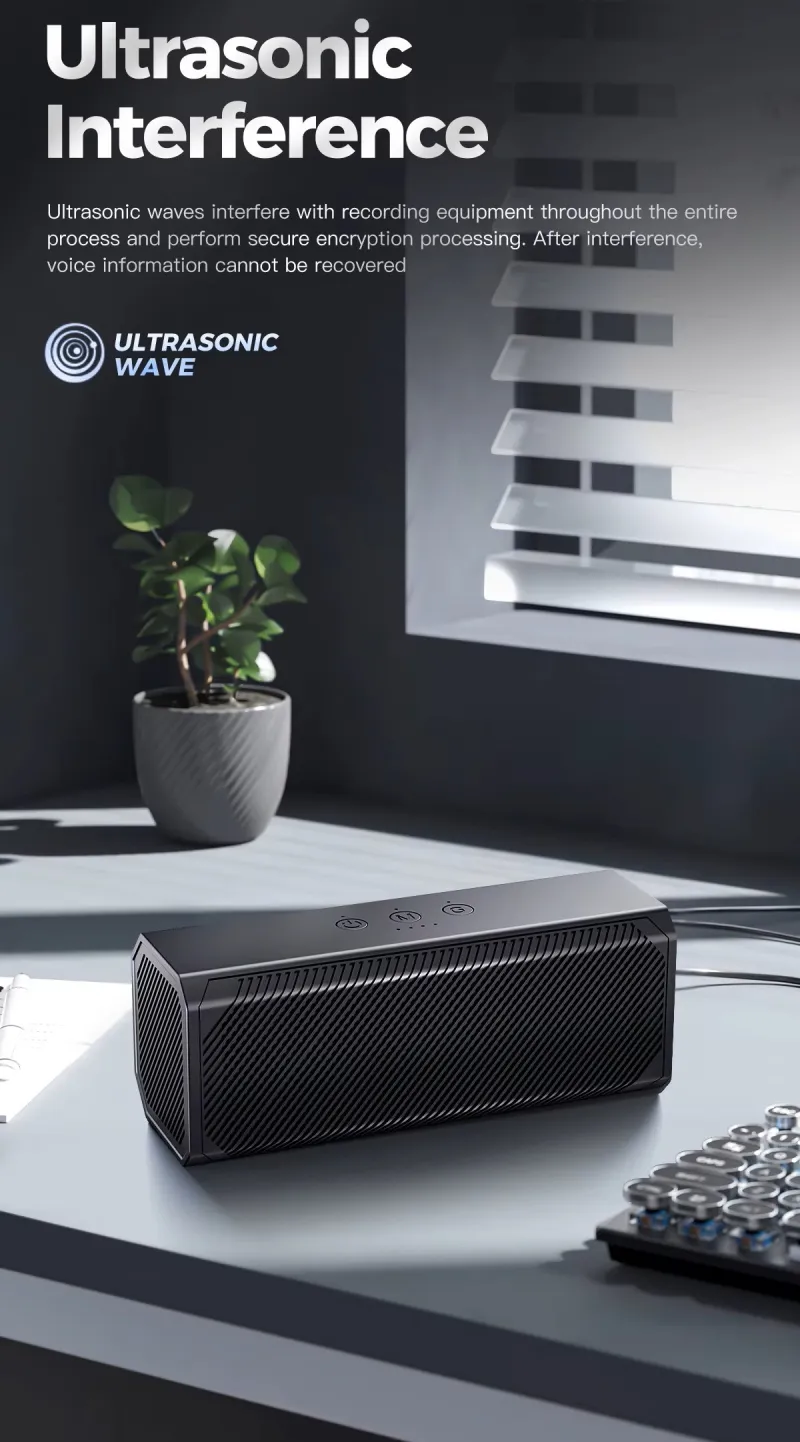
Photo: ultrasonic speaker device privacy home technology close up, via www.cool-mania.net
There's a guy in East Austin who builds what he calls "ambient shields." He works out of a converted garage, surrounded by oscilloscopes, soldering irons, and a whiteboard covered in frequency charts. He doesn't advertise. People find him the way people find anything useful and slightly illegal — through someone who already knows.
His tools look like speakers. Small, unassuming, the kind of thing you'd stick on a bookshelf next to a succulent. But they don't play music. They emit a carefully calibrated wash of ultrasonic and near-ultrasonic noise, tuned to interfere with the microphones embedded in smart speakers, security cameras, and the growing constellation of always-on devices that have quietly colonized American living rooms.
He's not alone. Across the country, a diffuse, largely underground community of acoustic engineers, privacy advocates, and plain old paranoids are developing and distributing tools designed to fight surveillance with sound.
The Listening Problem Nobody Wants to Talk About
Let's set the scene. The average American household now contains somewhere between five and fifteen "smart" devices — thermostats, televisions, doorbells, speakers, baby monitors. Most of them have microphones. Many of those microphones are technically always on, waiting for a wake word, a command, a reason to start transmitting.
The companies behind these products insist the data collection is minimal, anonymized, and secure. Privacy researchers and leaked internal documents have repeatedly suggested otherwise. Amazon, Google, and Apple have all faced scrutiny over instances of unintended recording, third-party data sharing, and the sheer volume of audio snippets being processed on remote servers.
For a growing segment of the population, the official reassurances stopped landing a long time ago. The question became not whether to trust the devices, but how to live around them.
Some people unplugged everything. Others moved. A smaller, more technically minded group started asking a different question: what if you could fight the signal?
Ultrasonic Interference and the Physics of Disruption
The core concept behind acoustic disruption isn't new. Researchers at universities including Princeton and Zhejiang have published peer-reviewed work demonstrating that microphones in consumer devices can be manipulated — confused, overloaded, or effectively blinded — using ultrasonic frequencies that human ears can't detect.
The technique exploits a quirk in how MEMS microphones (the tiny components inside most smart devices) process sound. Push certain frequencies at sufficient amplitude and the microphone's analog-to-digital converter starts producing garbage data. The device thinks it's hearing something, but the signal is useless noise. Effectively, you've jammed it without touching it.
Building a device that does this isn't wildly complicated if you have the right background. The components are available. The theory is published. What the underground community has added is the distribution layer — forums where designs get refined, group buys for components, and a loose network of builders who will assemble units for people who can't do it themselves.
"The hard part isn't the hardware," one member of a Signal-based group dedicated to acoustic privacy wrote in a thread. "The hard part is tuning it properly so you're not just making your dog miserable."
The Legal Gray Zone Is Very, Very Gray
Here's where things get complicated. Federal law — specifically the Communications Act and various FCC regulations — prohibits intentional interference with radio communications. But acoustic disruption doesn't operate in the radio spectrum. It operates in the physical world, through air pressure waves.
That puts it in a genuinely strange legal position. There's no specific federal statute that cleanly covers the act of emitting ultrasonic noise in your own home. Some legal observers have suggested it could theoretically be framed as tampering with electronic devices under certain state laws, or even as a violation of terms of service in ways that carry civil liability. But prosecutions? Nobody's found one.
"The law hasn't caught up," says a privacy attorney who asked not to be named because she occasionally advises people in this space. "Right now, if you're running one of these things inside your own home, you're probably fine. The moment you start pointing it at your neighbor's Ring camera, you're in different territory."
The community is aware of the distinction. Most of the discussion in these spaces is explicitly focused on personal use — protecting your own space, in your own home, from your own devices. The framing is consistently defensive rather than offensive.
Who's Actually Doing This
The demographic breakdown is messier than you'd expect. It's not exclusively tech bros or libertarian preppers, though both are represented. There are domestic abuse survivors who are terrified of being tracked through shared smart home devices. There are journalists and lawyers who handle sensitive information and have concluded that standard digital hygiene isn't sufficient. There are musicians and artists who've developed a kind of philosophical opposition to ambient surveillance as a cultural condition.
In Portland, a small community workshop has started hosting what they call "signal hygiene" nights — informal meetups where people learn to audit their home networks, identify active microphones, and build basic acoustic countermeasures. The vibe is somewhere between a maker space and a mutual aid meeting.
"It's not about being a conspiracy theorist," one regular attendee explained in a Reddit thread that has since been deleted. "It's about deciding for yourself what gets to listen to you in your own house."
Does It Actually Work?
The honest answer is: sometimes, partially, depending on the device and the implementation. Consumer smart speakers have shown measurable vulnerability in controlled lab settings. Real-world results are less clean. Devices vary. Placement matters enormously. Some manufacturers have begun hardening their microphone arrays against known interference techniques.
It's an arms race, which is maybe the most accurate frame for everything happening in this space. The tools get built, the companies adapt, the tools get refined. The signal and the static chase each other in circles.
What's notable is that the community keeps iterating anyway. The point, for many participants, isn't a perfect technical solution. It's the act of refusal itself — the insistence that the default relationship between a person and their devices should be negotiable.
In a world where the listening never fully stops, making noise might be the most coherent form of silence available.