Ears to the Sky: Inside the Obsessive World of Amateur Signal Hunters Cracking Government Transmissions
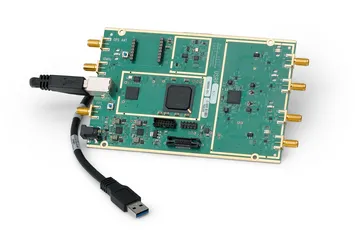
Photo: Ettus Research, CC BY-SA 4.0, via Wikimedia Commons
Mark — not his real name, though he's not particularly worried about anyone finding him — has been awake since 3 a.m. He's got three monitors running in a converted garage in central Ohio, each displaying a different waterfall display: the visual representation of radio frequency activity that looks, to the uninitiated, like a lava lamp designed by a mathematician. He's been tracking the same aircraft for six hours.
"It's not on any flight tracking app," he says, not looking away from the screen. "It's been circling the same forty-mile radius since midnight. That's not a commercial pattern. That's not a private plane. That's something working."
He records the transmission logs, cross-references the aircraft's transponder squawk code against a community database, and posts his findings to a forum that has about four thousand active members worldwide. Within twenty minutes, someone in Virginia has identified the airframe. Within an hour, someone else has pulled maintenance records suggesting the aircraft is operated by a federal contractor.
This is how the signal intelligence hobbyist community works. Distributed, methodical, and deeply, almost pathologically curious.
The Tools That Changed Everything
For most of radio's history, the equipment required to monitor government and military frequencies was expensive, specialized, and hard to obtain. That changed around 2012, when hackers discovered that cheap TV tuner dongles — little USB devices originally designed to receive digital television signals — could be repurposed as wideband software-defined radio receivers. The whole setup cost about twenty dollars.
Suddenly, anyone with a laptop and a basic antenna could receive signals across a massive swath of the radio spectrum. The software to process those signals — GNU Radio, SDR#, and a dozen other open-source platforms — was free. Forums and wikis emerged to document what was out there.
The community that formed around this technology is genuinely diverse. There are retired electrical engineers who treat it as a technical puzzle. There are former military signals personnel who find civilian monitoring oddly nostalgic. There are young people who stumbled in from adjacent corners of internet culture — the same communities that overlap with aviation tracking, open-source intelligence, and digital archaeology. And then there are people like Mark, who resist easy categorization and have simply been doing this for a very long time.
"I started listening to AM radio with my grandfather when I was eight," he says. "The idea that there's all this stuff in the air that most people are completely unaware of — that never stopped being interesting to me."
What They're Actually Hearing
The signal landscape above the United States is, it turns out, extraordinarily crowded.
The most accessible layer is military aviation communications — air-to-ground traffic on known frequencies that, while sometimes encrypted, often isn't. Training exercises, logistics coordination, even routine maintenance requests get transmitted in the clear. Hobbyists have built detailed maps of which frequencies are used by which bases, which airframes tend to appear in which regions, and what communication patterns suggest different types of operations.
Below that, things get stranger. Number stations — the enigmatic shortwave broadcasts of groups of digits read by synthetic voices — still operate, though in smaller numbers than during the Cold War. The community has documented dozens of active transmissions with no publicly acknowledged origin. Some are almost certainly foreign intelligence services. Others remain genuinely unattributed after years of analysis.
Then there are the anomalies. Signals that appear briefly on unusual frequencies and never repeat. Transmissions with encoding schemes that don't match any known standard. Bursts of data that seem to originate from locations where no transmitter should exist.
"Most of it has an explanation," says one community member who goes by the username Ferrite, and who has been active in signal hunting forums for over a decade. "Burst transmissions from automatic weather stations, old military relay systems that nobody bothered to shut down, weird intermodulation artifacts from nearby transmitters. But not all of it. Some of it we genuinely don't know."
The Gray Zone
The legal landscape here is worth addressing plainly, because the community thinks about it constantly.
In the United States, simply receiving radio transmissions — even encrypted ones, even on frequencies allocated to government or military use — is generally legal under federal law. The key distinction is in what you do with what you receive. Disclosing the contents of certain intercepted communications, particularly those involving wire communications or certain government transmissions, can cross into illegal territory under the Electronic Communications Privacy Act and related statutes.
Most serious hobbyists are careful about this. They document what they observe — frequencies, times, signal characteristics, aircraft positions — without publishing content. They share analysis, not transcripts. The community has developed informal norms around what gets posted publicly and what stays in private channels.
But the line isn't always obvious, and the community knows it.
"There's stuff I've recorded that I'm not going to post anywhere," Ferrite says. "Not because I think I did anything wrong by receiving it, but because I'm not trying to create a problem for myself or anyone else. You learn what to do with things."
What They've Actually Found
The more interesting question — the one that keeps driving new people into the hobby — is what the community has actually uncovered.
Some findings have been genuinely significant. Hobbyists have documented the existence of surveillance aircraft programs that were later confirmed by investigative journalists. They've mapped radio infrastructure — relay towers, ground stations, antenna arrays — that doesn't appear in any public database and whose operators have never acknowledged. They've tracked patterns in military communication that preceded publicly announced exercises or operations by days, providing a kind of unofficial early warning system.
Others have found things that remain unexplained. A group of hobbyists on the East Coast spent two years analyzing a recurring transmission on a frequency nominally allocated to a defunct government agency. The signal had characteristics suggesting a modern digital encoding scheme — not a relic of old infrastructure. It stopped abruptly in early 2023 and hasn't been heard since. Nobody has a satisfying explanation.
"The thing people don't understand about this hobby is that it's mostly boring," Mark says, pulling up another recording. "Hours and hours of nothing interesting. And then occasionally you hear something that makes you sit up very straight and think, okay, what is that. And you chase it. That's the whole thing. You chase it."
The Archive Mentality
What distinguishes the serious end of this community from casual listeners is the archival impulse. These aren't people who tune in occasionally and move on. They record everything. They timestamp, annotate, and catalog. They maintain databases of signal characteristics going back years. They build tools to automatically flag anomalies.
In a real sense, they're constructing a parallel record of electromagnetic activity above the United States — unofficial, crowdsourced, and largely invisible to the institutions being observed.
Whether that record matters, whether it will ever be used for anything beyond satisfying curiosity, is an open question. But the community keeps building it regardless, one waterfall display at a time, in basements and spare bedrooms across the country, ears permanently tilted toward a sky full of signals most people will never hear.